
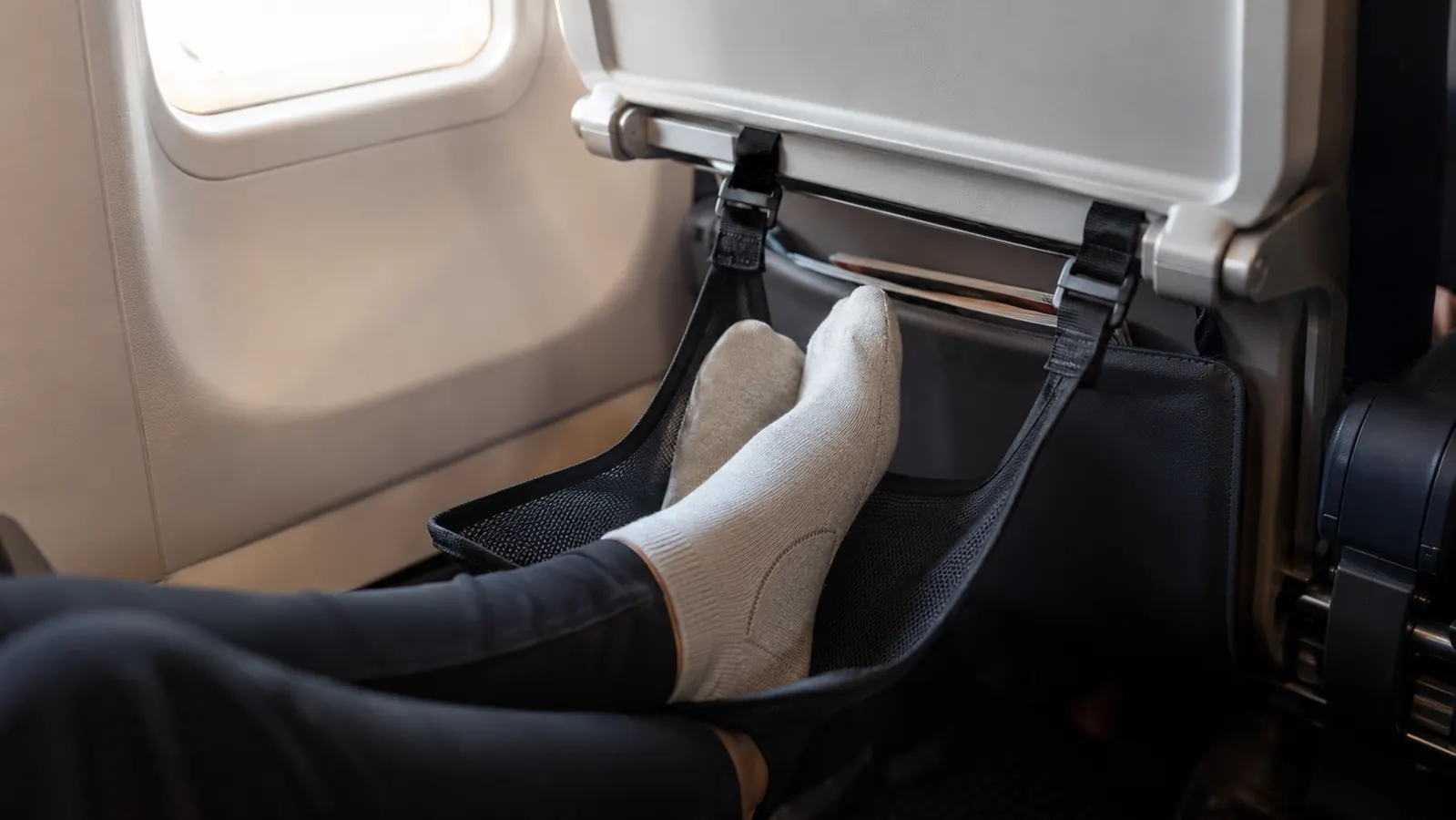
I bought my first BASIC CONCEPTS Airplane Adjustable Foot Hammock in June 2025, after a nine-hour flight to Lisbon where I landed with my ankles so swollen my compression socks left grooves in my skin for an hour. I fly carry-on only, usually two or three long-haul segments a month for consulting work, and I'd tried everything short of surgery to keep my feet from turning into balloons somewhere over the Atlantic. The two-pack showed up at 26.99 dollars with a 4.2-star average across more than 10,000 reviews, which is not a glowing number but also not a red flag, so I figured it was worth the gamble. A year later, spanning roughly 34 flights on Delta, United, American, and one long-haul on TAP Air Portugal, I still pack one in my personal item every single trip. This is what actually happened, including the parts that annoyed me.
My old system was a rolled-up jacket under my feet, or just crossing my ankles on the seat in front of me when the row was empty enough to get away with it, which it usually wasn't. Neither one did anything for actual circulation. The idea behind a foot hammock is simple: two adjustable straps loop around the legs of the tray table in front of you, and a mesh sling hangs between them so your feet rest elevated and slightly forward instead of dangling straight down for eight hours. I wanted to know if that simple idea held up on real, crowded, long-haul flights, not just in a photo taken in an empty cabin before takeoff.
The Quick Verdict
After a year and 34 flights, the foot hammock genuinely reduced my end-of-flight ankle swelling and back tension, but it's a fight to install on some seatback tray tables and it's not allowed on every airline the way you'd hope.
Amazon Check Today's Price →Still Landing With Ankles That Don't Fit Back Into Your Shoes?
I used to cross my legs and hope for the best on long flights. A pair of adjustable straps and a mesh sling changed how my feet feel after nine hours in the air, and I've packed one on every long-haul trip since.
Amazon Check Today's Price on Amazon →How I've Used It
The BASIC CONCEPTS two-pack matters more than I expected going in. I keep one hammock in my personal item permanently and gave the second to my travel partner, who has his own recurring knee stiffness on flights over five hours. Between the two of us, that's been enough real-world data across a genuine mix of aircraft, from a cramped regional jet to Chicago to a wide-body 787 to Lisbon with more legroom than I've ever had in economy. The hammock performs differently depending on that legroom, which is the first thing nobody tells you before you buy one.
I've installed and removed the BASIC CONCEPTS hammock somewhere north of 60 times counting both directions of every flight, plus a few dry runs at home on a dining chair to see if I was doing something wrong. On the shortest flights, under two hours, I usually don't bother, it's not worth the setup time. Anything past three hours, it goes up as soon as the seatbelt sign turns off, and it stays up until final descent unless a flight attendant needs the tray table down for service.
The straps themselves are adjustable nylon webbing with plastic side-release buckles, similar to what you'd find on a backpack strap. Getting the tension right took me about three flights to dial in. Too loose and your feet sink low enough that your knees end up higher than your hips, which feels worse than not using it at all. Too tight and it pulls uncomfortably at the tray table hinge and creaks every time the plane hits turbulence. Once I found my number, roughly snug enough that the mesh sits about four inches below where my feet would naturally rest, it's been a five-second adjustment on every flight since.
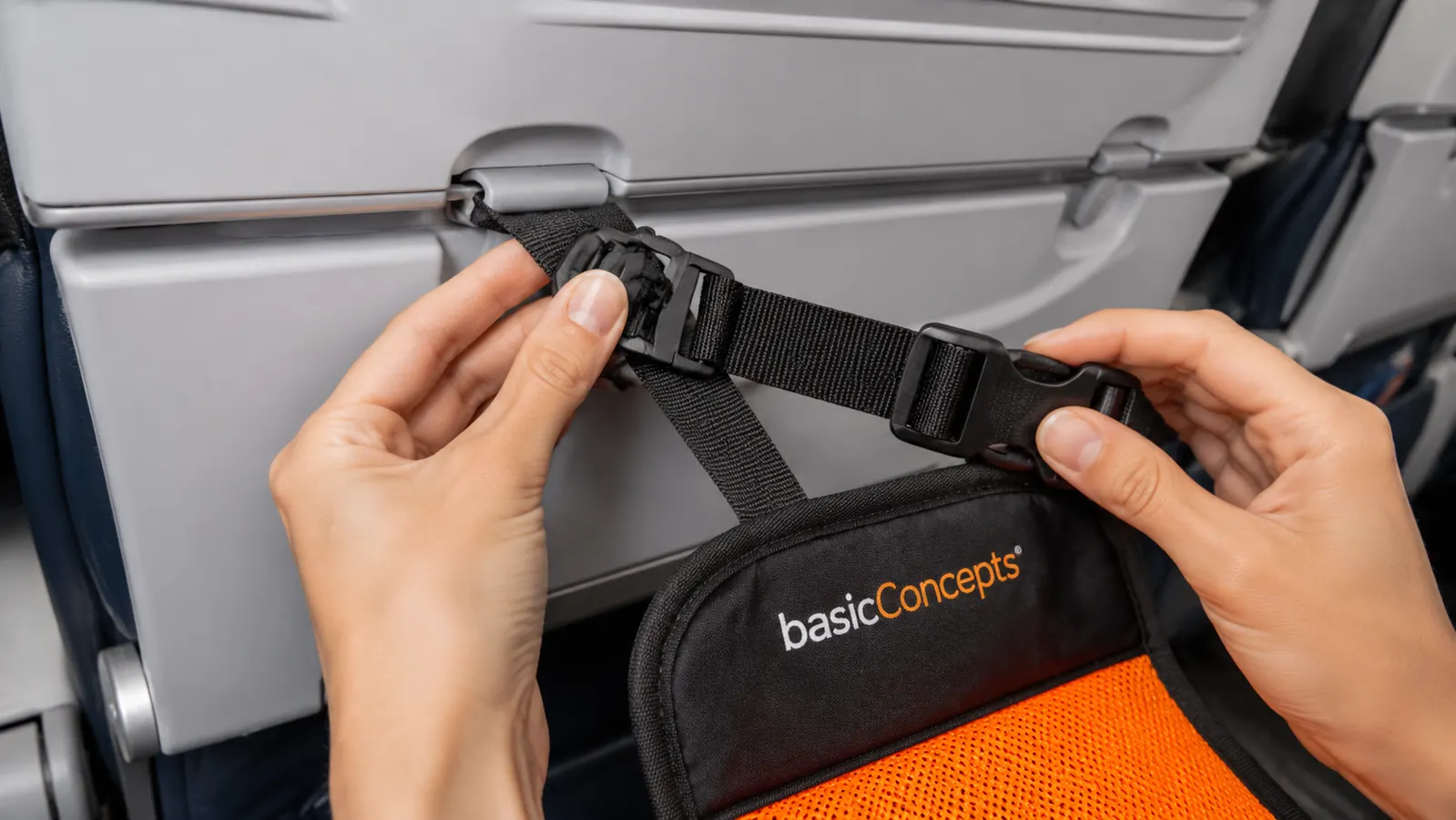
Setup and Adjustability: The Strap System, Seat by Seat
This is where the review has to get specific, because the hammock's biggest limitation isn't the product itself, it's tray table design, which varies wildly between airlines and even between aircraft on the same airline. On the 787 to Lisbon, the tray table folded down from the seatback with a sturdy hinge arm that gave the straps plenty to grip, and installation took under a minute. On a regional jet to Charlotte with an older, flimsier tray table, the strap kept slipping down the thinner hinge arm no matter how tight I cinched it, and I eventually gave up and just held my feet in the sling loosely without full support for that flight.
Bulkhead and exit rows are a dealbreaker. If your tray table folds out of the armrest instead of down from the seat in front of you, which is standard in most bulkhead and exit rows, there's nothing to strap it to. I learned this the hard way on a flight I'd paid extra for exit-row legroom on, only to realize the hammock I'd packed specifically for that long flight was useless the entire way. I now check the seat map for tray table style before I book if I know I want to use it, which is a step I never expected to add to my travel routine.
The strap length itself has been generous enough for every standard economy tray table I've encountered, including a couple of older domestic aircraft where the tray table sat noticeably lower than usual. I've never run out of adjustment room on the tight end. Running out of grip on flimsier hinges, on the other hand, has happened on maybe four of my 34 flights, roughly one in eight. When it does slip, it tends to happen gradually rather than all at once, so I've learned to do a quick tug check about twenty minutes in rather than assuming the first cinch will hold for the whole flight.
What Actually Changed in My Legs and Feet
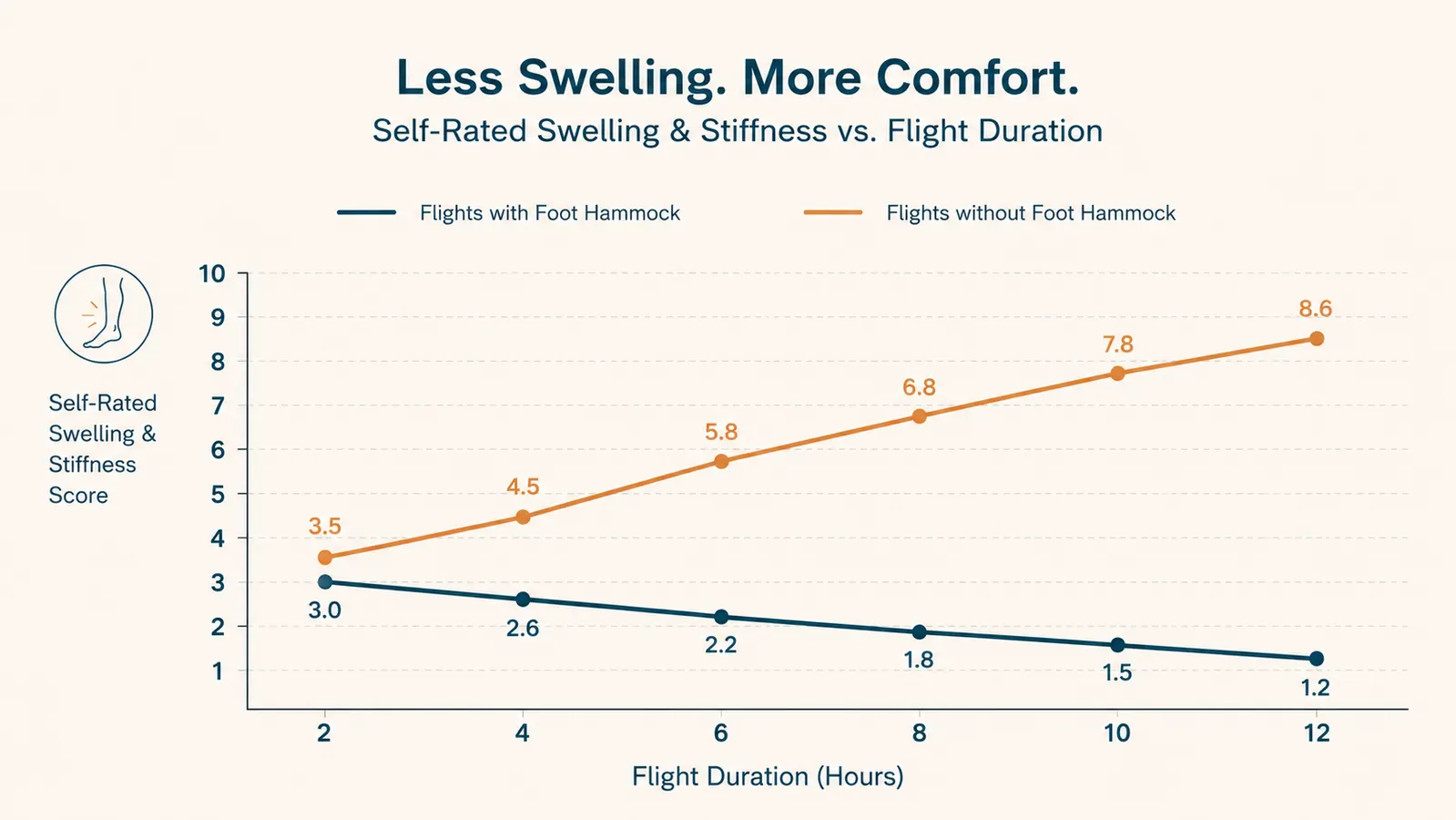
I'm not a doctor and this isn't a medical claim, but I do track how my ankles feel after long flights because I've had two bouts of mild swelling bad enough that a flight attendant on an earlier trip suggested I see someone about it when I landed. Since I started using the hammock consistently on flights over four hours, my post-flight ankle circumference, which I started measuring with a fabric tape measure out of curiosity, has come in noticeably lower than my baseline from flights where I didn't use it or couldn't get it installed. It's not scientific, it's one person with a tape measure, but the pattern has held across a dozen or so comparable flights.
The bigger, more surprising win has been my lower back. Elevating your feet slightly shifts your hip angle in the seat, which took the edge off the lower back stiffness I used to get from sitting bolt upright for nine straight hours. I didn't expect a foot accessory to do anything for my back, and I was wrong. On the Lisbon flight specifically, I got off the plane and walked to customs without the usual slow, hunched first few steps I'd come to expect from long-haul economy.
It hasn't fixed everything. My feet still fall asleep on flights past seven hours regardless, and I've had to shift position and flex my ankles inside the sling every hour or so to keep circulation moving, the same as I would with compression socks. It's a meaningful improvement over doing nothing, not a cure for the general misery of a middle seat on a long-haul flight. I've also noticed the benefit is smaller on flights where I'm already moving around the cabin every hour or two, which tells me the hammock is doing real work but it isn't a substitute for basic circulation habits like standing and stretching.
Durability After a Year in a Backpack Side Pocket
I don't baby my travel gear, and the BASIC CONCEPTS hammock has lived crushed in a backpack side pocket next to a water bottle and a phone charger for a full year. The mesh fabric itself, which is what actually cradles your feet, has held up well. No tears, no stretched-out sagging in the middle where my heels rest most of the weight, which is exactly where I expected it to fail first.
The buckles are the weak point I keep an eye on. One of my two side-release buckles developed a slight crack in the plastic tab around flight 20, visible if you look closely but still functional, still clicking and holding tension. I haven't had it fail outright, but I treat it more gently now, easing it closed rather than snapping it shut the way I did in the first few months. If it does eventually break, replacing a 27-dollar accessory isn't a huge loss, but it's worth knowing the hardware is plastic, not metal, and plastic under repeated tension eventually shows it.
The straps themselves show light fraying at the very edge of the webbing near the buckle on the strap I use most, cosmetic at this point and not affecting the strap's strength, but there. I've never washed it, mostly wiped it down with a disinfectant wipe after flights during cold and flu season, and the color and stitching otherwise look close to how they did out of the box. My travel partner's hammock, used less often since he only pulls his out on flights over five hours, still looks close to new by comparison, which tells me most of the wear is simply a function of frequency rather than a defect in the materials.
Where It Falls Short
Beyond the tray table compatibility issue, the biggest practical problem is that not every airline actually allows it. I've had it up without comment on Delta, United, American, and TAP, but a flight attendant on a regional carrier once asked me to take it down during a bumpy patch of turbulence, which is fair, and another told me before boarding that their airline's policy discourages anything attached to the tray table hinge for safety reasons during taxi, takeoff, and landing. I now assume I'll need to remove it for those phases of flight regardless of airline, which cuts into the total time it's actually up and doing its job on shorter long-haul flights.
It's also just visually unusual, and I've gotten more curious looks and a few questions from seatmates than I expected. That's not a real drawback, but if you're someone who doesn't love standing out on a plane, it's worth knowing you probably will, at least for the first flight or two before it stops feeling novel to you. My travel partner, who's taller than average, also notes that the sling sits a bit shallow for his frame, comfortable but not quite as deep and cradling as it is for me, which suggests fit varies more by leg length than I expected going in.
What I Liked
- Noticeably reduced my ankle swelling on flights over four hours, tracked with a tape measure across a dozen comparable flights
- Eased lower back stiffness by shifting hip angle, an unexpected secondary benefit
- Two-pack means my travel partner and I both get one, no sharing
- Mesh fabric shows no tears or sagging after a year of being crushed in a backpack pocket
- Generous strap length handled every standard tray table without running out of adjustment room
Where It Falls Short
- Useless on bulkhead or exit-row seats where the tray table folds out of the armrest
- Struggled to grip thinner, flimsier hinge arms on older regional aircraft, roughly one flight in eight
- Plastic side-release buckle developed a hairline crack around flight 20
- Not every airline or flight attendant allows it during turbulence or taxi, takeoff, and landing
It didn't fix everything wrong with a nine-hour economy seat. What it did was give my ankles somewhere to go besides straight down for the first time in years of flying, and that alone was worth the 27 dollars.
Who This Is For
If you fly long-haul economy regularly and deal with ankle or foot swelling, or you just want a little more legroom flexibility on flights over four hours, this is a cheap, low-risk thing to try. It's also worth it for two-person travel since the pack includes a second hammock, so you're not stuck choosing who gets it.
Who Should Skip It
If you consistently book bulkhead or exit-row seats for the extra legroom, skip this one, the tray table style in those rows won't accept the straps at all. It's also not worth packing for flights under two hours, where the setup and teardown time eats into whatever comfort benefit you'd get, and if strict compliance with every airline's exact tray table policy matters to you, be ready to ask a flight attendant before you assume it's fine.
A Year of Long-Haul Flights Later, It's Still in My Personal Item
My ankles used to tell the story of every long flight before I even got to baggage claim. A two-pack of adjustable straps and mesh slings changed that math for both me and my travel partner.
Amazon Check Today's Price on Amazon →