
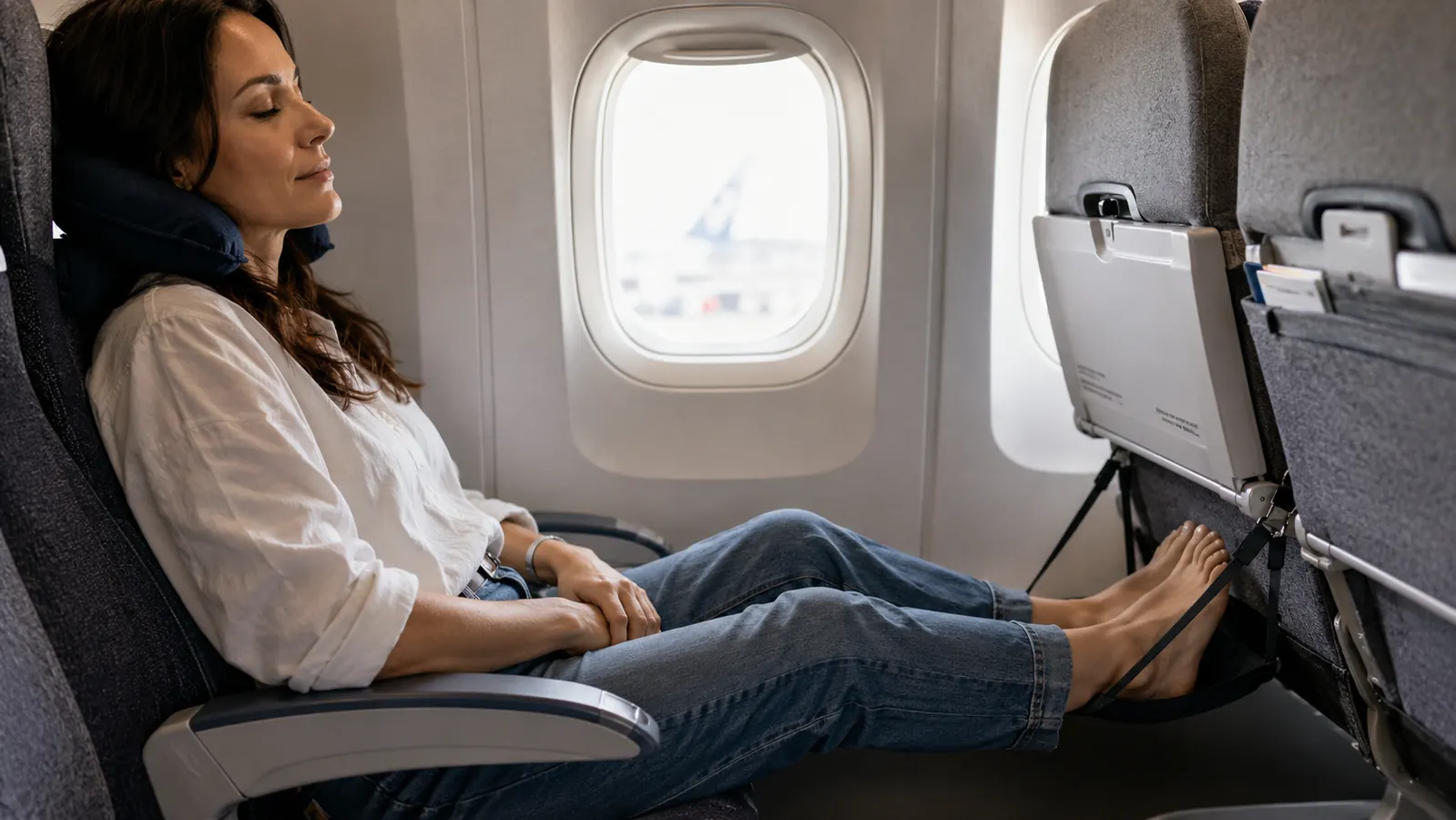
I didn't take swollen feet seriously until a 14-hour flight to Auckland left me unable to get my sneakers back on for the walk to baggage claim. My ankles had puffed up so much that my socks left deep red lines, and it took almost a full day on the ground before my feet looked like my feet again. That flight is the reason I started rigging a BASIC CONCEPTS foot hammock under my tray table on anything longer than four hours, and it's the single biggest change I've made to how my body feels after long-haul travel. This isn't about comfort alone. It's about keeping blood and fluid moving through legs that are stuck in the same bent position for hours at a time, and having a system for it instead of just hoping for the best.
Swelling happens on planes because gravity and stillness team up against you. When you sit with your feet flat on the floor for hours, blood pools in your lower legs and fluid pushes out into the surrounding tissue, which is what causes that tight, puffy feeling by hour six or seven. Cabin pressure also sits lower than sea level, which can make the effect more noticeable than a long car ride or a day at a desk. None of that means you're doomed to land with cankles every time. It means you need a routine that keeps your legs elevated, keeps your ankles moving, and doesn't rely on remembering to do any of it on your own halfway through a movie. That's what the steps below are built around.
This routine works for the flights that actually cause the problem: anything past four hours, red-eyes where you're seated still for six or eight hours straight, and back-to-back connections where you never really get up between legs. I fly economy almost exclusively, aisle or window depending on the route, and everything below is written for that seat, not a lie-flat business class pod where you can already stretch out. If your travel days look like mine, cramped rows and long stretches without a real walk, this is the setup that's kept my feet normal-sized since I started using it.
Stop Landing With Ankles You Don't Recognize
The BASIC CONCEPTS foot hammock straps to the tray table arm in under a minute and lets you elevate your feet just enough to keep circulation moving for the whole flight. It comes as a two-pack, so you can rig one for yourself and one for whoever's flying with you.
Amazon Check Today's Price on Amazon →Step 1: Rig the hammock at the right height before you settle in
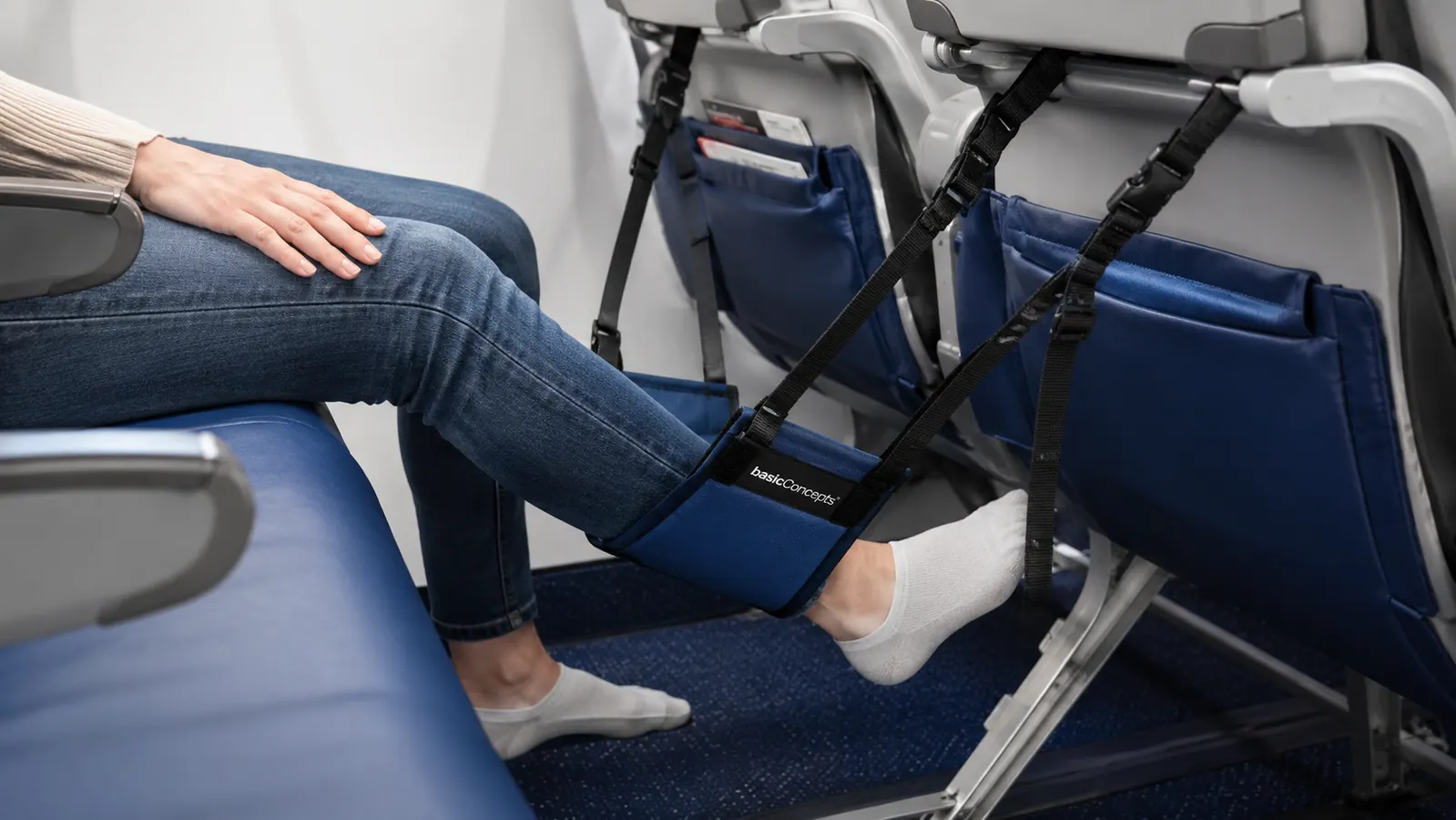
The height you set the hammock at matters more than most people realize when they first unpack one. Set it too high and your knees end up jammed against the seatback tray, which gets uncomfortable fast and annoys the person reclining in front of you. Set it too low and you're barely elevating your feet above where they'd sit on the floor anyway, which defeats the point. I aim for a height where my knees sit at roughly the same level as my hips, maybe a touch below, with my heels resting in the fabric and my toes free to move.
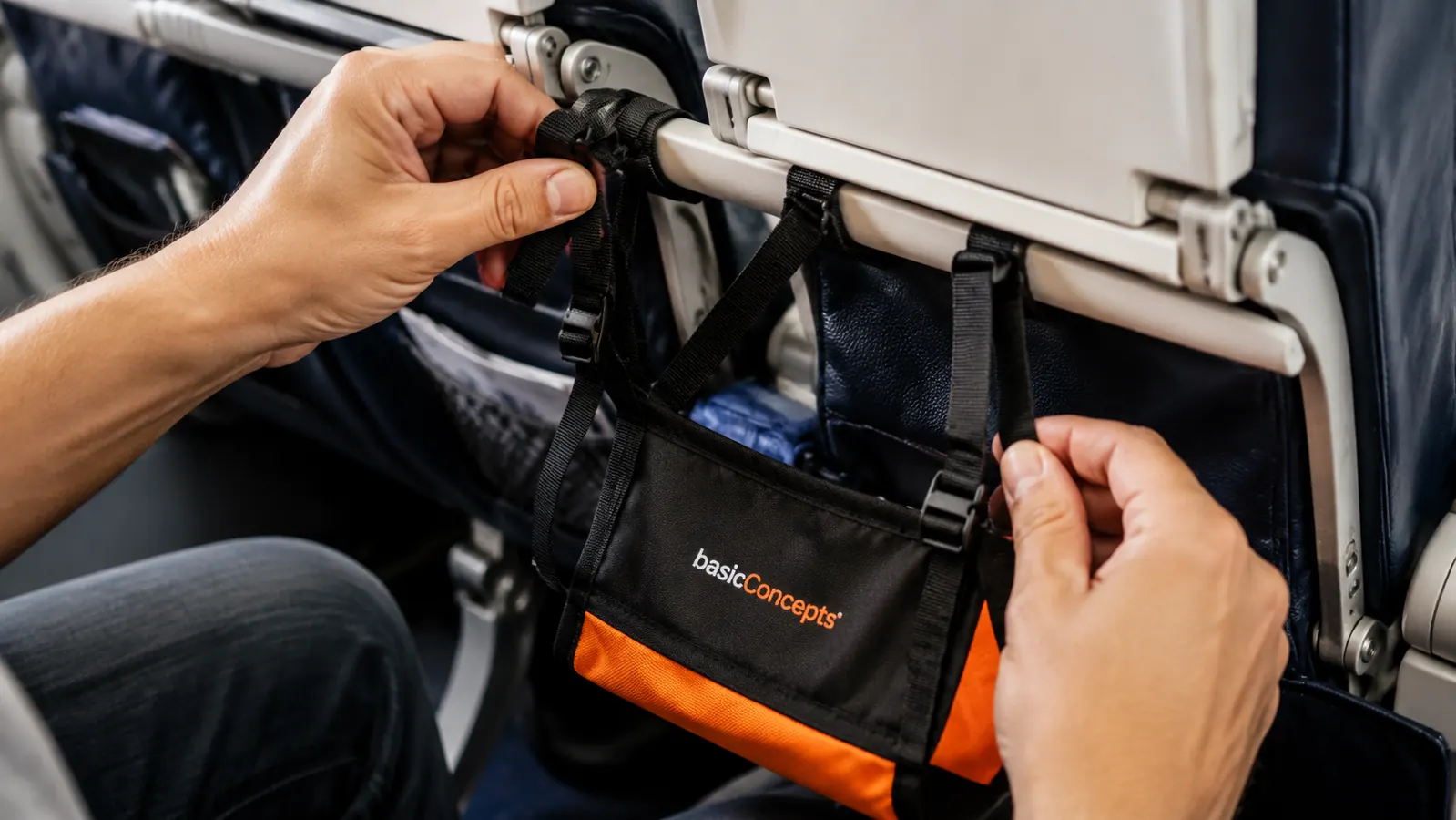
Do this before the seatbelt sign goes off, not after you're already settled with a laptop out. The straps on the BASIC CONCEPTS hammock loop around the tray table arm and adjust with a simple slide buckle on each side, so it takes maybe 30 seconds once you've done it a couple of times. I always double-check both sides are even before I trust my full weight in it, since an uneven rig will slide your feet to one side over a few hours and undo the whole benefit.
One thing I learned the hard way on an early flight: don't rig it so tight that your feet feel locked in place. You want enough give that you can still rotate your ankles and shift position without unclipping anything. A hammock that's rigid as a shelf just trades one static position for another, and static is exactly what causes the swelling in the first place.
Since it ships as a two-pack, I keep the second one in my carry-on for whoever I'm traveling with, usually my husband, rather than leaving it at home. It's also worth checking your specific tray table before you fly. Some newer aircraft have thinner mounting arms or a tray that folds differently, and it's easier to test the fit while you're still boarding and can adjust without holding up the aisle behind you.
Step 2: Alternate elevated and flat positions every 45 to 60 minutes
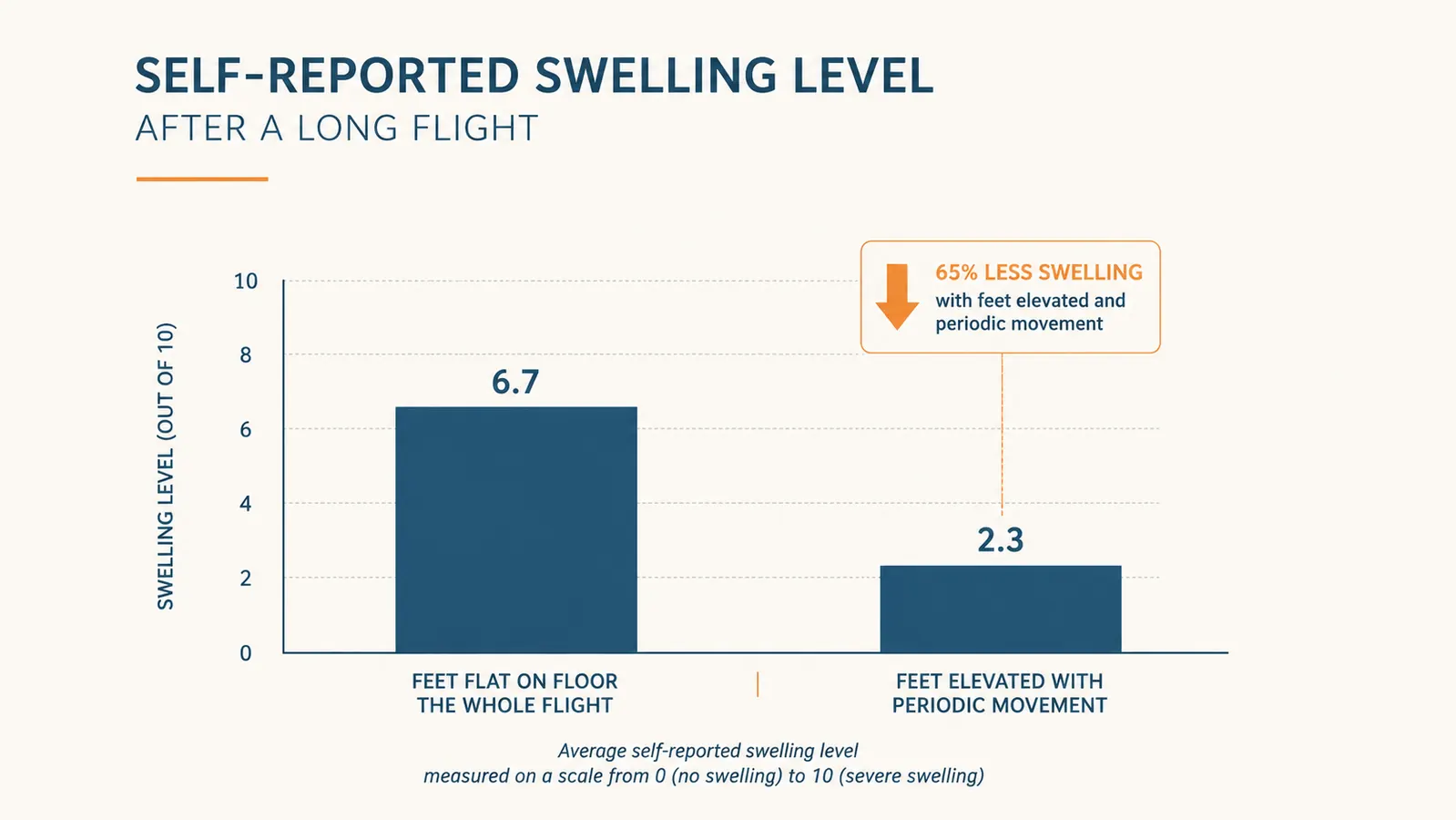
Elevating your feet helps, but staying in any single position for the entire flight, even an elevated one, still limits circulation. I set a quiet timer on my phone for 45 minutes and use it as a cue to drop my feet flat on the floor for five or ten minutes before going back into the hammock. It's a small habit, but it keeps blood moving in both directions instead of just pooling differently.
This is also a good moment to flex your feet up and down a few times, the way you'd point and flex in a stretch class, before settling back into the hammock. I usually do this during a drink service or a seatbelt sign moment anyway, so it doesn't feel like an interruption to whatever I'm watching or reading. It becomes automatic after a flight or two.
I've noticed the alternating matters more on flights where I fall asleep for a stretch, since I can't consciously shift position while I'm out. On those flights I try to time my last position swap right before I expect to doze off, so I'm not stuck in one setup, elevated or flat, for four or five hours straight without noticing. A window seat helps here since you're not disturbing a neighbor every time you move your feet in and out of the hammock.
Step 3: Pair the hammock with ankle circles and calf pumps
The hammock handles elevation, but it doesn't move your muscles for you, and muscle movement is what actually pushes blood back up toward your heart against gravity. Every time I take a break from the elevated position, I do 15 to 20 ankle circles in each direction, then a set of calf pumps, pushing my toes down and pulling them back up like I'm tapping an invisible gas pedal. It takes maybe two minutes total and it's the part of the routine that made the biggest visible difference for me, more than the hammock alone.
I do this seated, feet still resting on the hammock's edge or lifted slightly out of it, so I'm not disturbing anyone next to me. If you're in a window seat and don't want to make it a production, you can do the calf pumps with your shoes still on, tucked under the seatback in front of you. Nobody notices, and your legs feel noticeably less heavy by the time you land.
I picked this habit up from a flight attendant on a long Delta flight years ago, back before I had the hammock at all, and it's stuck with me since. She mentioned that crew members do the same ankle and calf routine on standing breaks during long-haul shifts, since they're on their feet for the whole flight and dealing with the same static-position problem from the opposite direction. It's a cheap, two-minute habit that costs nothing and works whether or not you have any gear with you at all.
Step 4: Manage hydration, salt, and compression alongside the hammock
The hammock and the movement breaks do a lot of the work, but what you put into your body during the flight matters too. Cabin air is dry, and dehydration makes your body hold onto sodium and fluid more aggressively, which shows up as swelling in exactly the places you don't want it. I drink water steadily through the flight instead of one big bottle at boarding, and I skip the free soda and the second glass of wine on anything longer than five hours, since both tend to make my ankles puffier by landing.
I also wear a pair of graduated compression socks under the hammock setup on flights longer than seven or eight hours. The two work together rather than replacing each other. Compression socks help your circulatory system push fluid upward the whole flight, while the hammock keeps your legs from sitting in the worst position for that fluid to pool in the first place. On shorter flights I'll often skip the compression socks and just rely on the hammock and movement breaks, and that's usually enough.
Airplane food doesn't help either. The pretzels, the pre-packaged meals, most of what gets handed out on a long flight runs high in sodium, and sodium pulls water into your tissue right along with everything else working against you. I've started packing my own snacks, unsalted nuts and dried fruit mostly, for anything over six hours, and it's a small change that noticeably reduces how tight my shoes feel by the time we start descending.
Step 5: Know when to skip the hammock and just get up
A quick, non-medical note here. If you have a diagnosed circulation condition, a history of blood clots, or you're pregnant, talk to your doctor before you fly about what elevation and movement routine actually makes sense for you, since your situation may need a different approach than a general travel routine like this one. This article is built for typical, healthy travelers dealing with ordinary flight swelling, not a substitute for medical guidance.
Even without any of that, there are flights where the hammock isn't the right call. If my legs feel unusually tight, tingly, or noticeably more swollen on one side than the other, I skip the hammock, get up, and walk the aisle instead, sometimes for ten or fifteen minutes at a stretch. The hammock is a tool for a normal long flight, not something to force through if your body is telling you something's off. On red-eyes where I know I'll actually fall asleep for hours at a time, I'll sometimes leave the hammock rigged but set an alarm to wake and walk once mid-flight, since sleeping through six hours of total stillness is its own risk regardless of elevation.
What Else Helps
The foot hammock is the centerpiece of my routine, but a few other habits round it out. I avoid crossing my legs at the knee for long stretches, since it restricts flow right at the point I'm trying to keep open. I loosen my shoelaces or switch to slip-ons an hour or two into the flight, once my feet have naturally expanded slightly at altitude, rather than fighting tight laces the whole way. And on the ground before boarding, I try to get a real walk in through the terminal instead of sitting at the gate the entire layover, since starting the flight already stiff makes the first few hours worse. None of these replace the hammock. They just stack on top of it, the same way the movement breaks and compression socks do.
An aisle seat also makes the whole routine easier to keep up, since you're not asking a stranger to move every time you want to stand and walk. If I'm booking a long-haul flight and have the choice, I'll pay a little extra for the aisle specifically so I don't talk myself out of the movement breaks halfway through the flight just to avoid the awkwardness of climbing over someone. Small logistics like seat choice end up mattering as much as the gear itself.
Elevating your feet without moving them just trades one static position for another. The hammock only works as part of a routine, not as a set-it-and-forget-it fix.
Rig It Once, Use It On Every Flight After
I've flown transpacific routes, red-eyes, and everything in between with the BASIC CONCEPTS foot hammock strapped under my tray table. It packs flat, takes under a minute to set up, and it's the reason I stopped dreading how my feet feel after landing.
Amazon Check Today's Price on Amazon →