

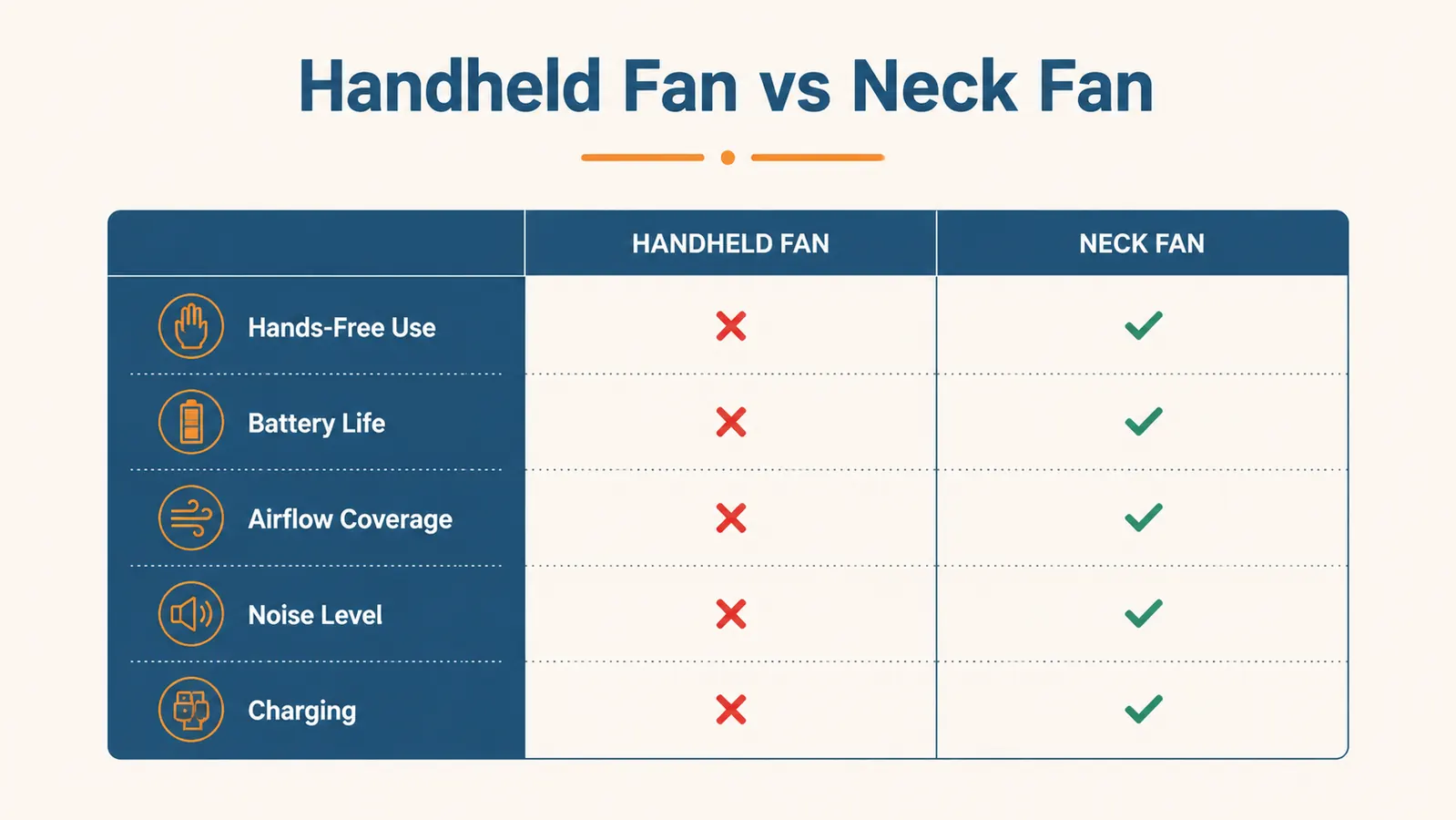
I used to carry a twelve-dollar handheld fan clipped to the side pocket of my rolling bag, the kind with three plastic blades that rattled every time the wheels hit a seam in the jet bridge floor. It worked, technically, but only if I stopped walking, dug it out, and held it up to my face with one hand while my boarding pass and passport slid around in the other. That fan lasted exactly one trip through a sweltering Newark terminal in July before I gave up and bought a JISULIFE Portable Neck Fan instead. It hangs around your neck, blows air on both sides of your face at once, and never once needs a free hand. Once you travel with a hands-free fan, going back to a handheld one feels like going back to a flip phone.
None of the ten reasons below are hypothetical. Every one of them came from an actual airport, an actual layover, or an actual rideshare pickup where I had a bag in one hand, a phone in the other, and sweat running down my back regardless. A handheld fan assumes you have a spare hand to give it. A neck fan assumes you don't, which on a real travel day is almost always the more accurate assumption.
Tired of choosing between holding your fan and holding your boarding pass?
The JISULIFE Neck Fan holds a 4.3-star rating across more than 62,000 reviews, runs five adjustable speeds, and recharges off a 4000 mAh battery that outlasts most travel days. Check today's price before your next terminal sprint.
Amazon Check Today's Price on Amazon →Both Hands Stay Free for Bags, Boarding Passes, and Coffee
A travel day rarely gives you a spare hand. You've got a rolling bag in one, a phone or boarding pass in the other, and maybe a coffee balanced somewhere in between. A handheld fan just doesn't fit into that math, so it sits unused in a bag pocket more often than it actually runs. The JISULIFE fan drapes around your neck and stays there, blowing air the entire time you're wrangling luggage through security.
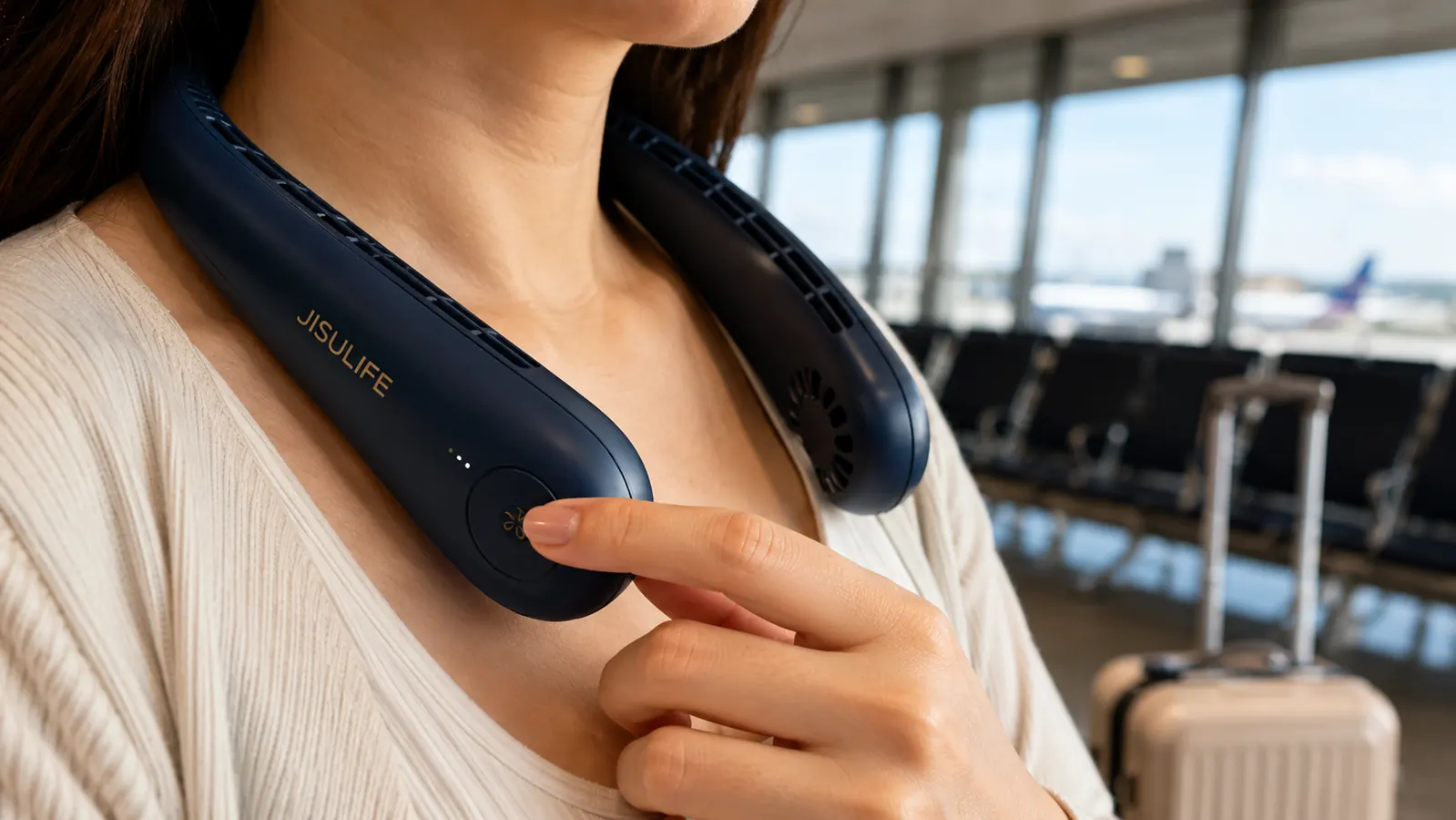
Airflow Hits Both Sides of Your Face at Once
A handheld fan is a single narrow stream aimed wherever you happen to be pointing it, which usually means one cheek gets cool air and the other one doesn't. The JISULIFE's bladeless design pushes air out of vents on both sides, so it cools your jaw and neck evenly instead of just the one spot you remembered to aim at. In a packed terminal with no air conditioning to speak of, that even coverage actually matters.
The 4000 mAh Battery Actually Outlasts a Travel Day
Most handheld fans run on two AAs or a tiny built-in cell that taps out in under an hour, right around the time you actually need it most. The JISULIFE's 4000 mAh battery gets me from curbside check-in through boarding, a full flight, and the walk to a rideshare on the other end. I've genuinely never had it die mid-trip, which I can't say for a single handheld fan I owned before it.
No Exposed Blades Near Luggage Straps or Loose Hair
Handheld fans with real spinning blades are a small hazard in a crowded terminal, catching on a lanyard, a loose strand of hair, or a curious kid's finger. The JISULIFE is fully bladeless, just quiet internal fans venting through mesh, so I never think twice about wearing it while my scarf is loose or while I'm bent over retying a shoe.
Five Speed Settings Instead of One Blast of Air
A lot of handheld fans are just on or off, one setting, take it or leave it. The JISULIFE has five speeds, so I run it low while I'm sitting at the gate reading and bump it up the second I step onto a hot jet bridge or a tarmac bus with no air moving. Having that range means the fan actually matches the moment.
Quiet Enough to Wear at a Gate Without Annoying Your Row
Handheld fans buzz right next to your ear because that's where you're holding them, and that hum carries to the seats around you. Worn around the neck and set below the top speed, the JISULIFE is quiet enough that I've had seatmates not notice it's running at all. I save the top speed for open terminal walkways, not for a middle seat on a full flight.
It Stays On During a Layover Nap
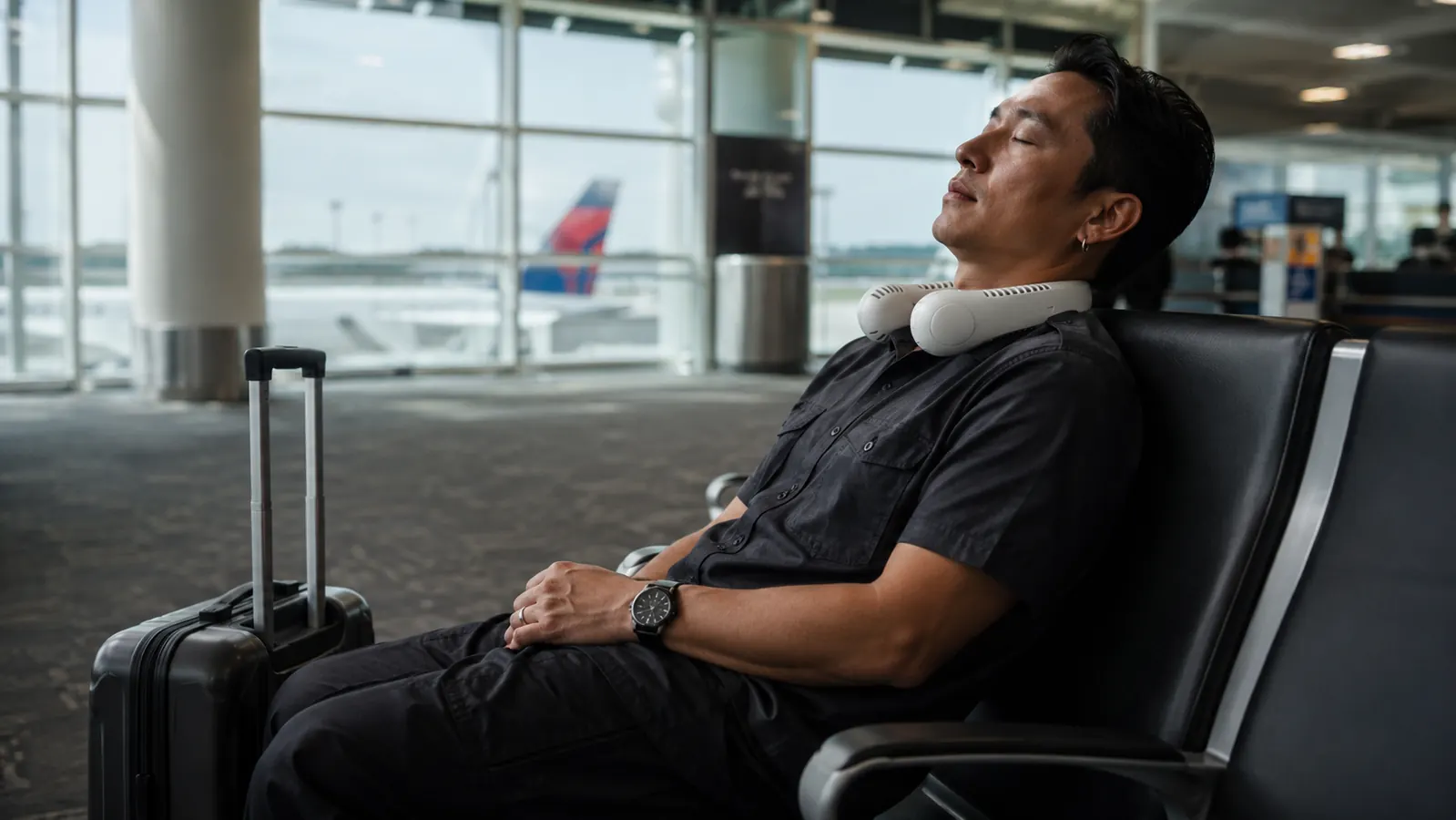
A handheld fan falls out of your hand the second you doze off in a gate chair, which is exactly when a delayed layover tends to happen. The JISULIFE just stays worn, still running on low, while I lean my head back and close my eyes for twenty minutes between flights. I've woken from more than one accidental gate nap without ever dropping it or losing my place in the boarding line.
USB-C Charging Means One Cable for Your Whole Bag
Cheap handheld fans usually want AA batteries you have to remember to pack, or a proprietary cable you'll never find again once it's lost in a side pocket. The JISULIFE charges off USB-C, the same cable already in my bag for my phone and laptop, so it's one less item to track at 5 a.m. security lines.
Built for Walking, Not Just Sitting Still
A handheld fan basically requires you to stop moving, since you need a free hand to run it, and stopping in a crowded terminal is its own kind of stressful. The JISULIFE keeps blowing air while I'm actively power walking to a gate change with a bag in each hand. It's the difference between a fan you use for thirty seconds and one that runs the whole walk.
It Doesn't Draw the Same Attention as Waving a Fan Around
Waving a handheld fan around in a security line or a packed jet bridge takes elbow room you don't have, and it always feels a little conspicuous, like you're the one person visibly overheating. The JISULIFE just sits there around your neck, doing its job without asking anyone else for space. I've had more people ask where I got mine than ever comment on a handheld fan.
What I'd Skip
I'd skip any bladeless neck fan that only vents from one side or the front, since that's the exact single-stream problem a handheld fan already has, just worn differently. I'd also skip anything that doesn't list an actual battery capacity in the specs, a listing with no mAh number is usually hiding a small, weak cell. I ran the JISULIFE through six months of actual trips, packed flights, layovers, and one memorably hot connection in Phoenix, in my long-term JISULIFE review.
The best travel fan isn't the one you hold up to your face. It's the one you forget you're wearing until you notice everyone else is sweating and you're not.
If staying cool through the whole terminal, not just at the gate, is the bigger problem you're solving for, the airport-specific routine I actually use covers the rest, when I turn the fan on, where I sit, and what else helps in a building with no real airflow.
Related: JISULIFE Neck Fan Review: 6 Months of Real Travel | How to Stay Cool in Airports With a Neck Fan
Stop giving your fan a hand it can't spare.
Once you've traveled hands-free with a neck fan, digging a handheld one out of your bag every time you overheat feels like a step backward. Check today's price and pack the JISULIFE before your next hot terminal.
Amazon Check Today's Price on Amazon →