

I own both kinds of travel fan, and for two years I carried a cheap handheld one before I finally switched to the JISULIFE neck fan and never looked back for anything except a quiet window seat. The short answer, if you're standing in an airport gift shop right now trying to decide between them: the JISULIFE wins for anyone actually moving through an airport, and the handheld fan wins for anyone who's mostly sitting still. That distinction matters more than it sounds like it should, because most of a travel day isn't sitting. It's walking a concourse, rolling a bag, holding a boarding pass, wrangling a kid by the hand, or standing in a security line with your fingers full of exactly zero free space.
I tested both on the same trip, an August run from Tampa to Denver with a 90-minute layover in Charlotte, tarmac temperatures in the high 90s and a jammed connecting terminal with broken air conditioning near gate C14. I carried the JISULIFE around my neck from curb to rental counter and switched to the handheld fan only when I was seated, just to give both a fair shot under the exact same conditions instead of judging one at a desk and the other in a living room.
The two fans aren't really competing for the same job, which is part of why so many travelers end up owning both and reaching for the wrong one out of habit. A handheld fan was designed for a person sitting on a porch, pointing a breeze at their own face and nowhere else. A neck fan like the JISULIFE was designed for a person in motion, which is closer to what an actual travel day looks like from the moment you get out of the rideshare to the moment you finally collapse into a hotel bed.
Below is the full breakdown I wish someone had handed me before I bought my first cheap handheld fan at an airport kiosk out of desperation. Price, portability, battery, and noise all matter, but they matter differently depending on whether you're sitting or moving, and that's the piece most quick comparisons skip.
| Neck Fan | Handheld Fan | |
|---|---|---|
| Price Tier | Higher upfront cost. See today's price on Amazon | Lower upfront cost, typically in the budget travel-accessory range |
| Hands-Free Use | Yes, wears around the neck, both hands stay free for bags and boarding passes | No, occupies one hand for the entire time it's running |
| Airflow Style | Dual bladeless vents aim upward at the jaw and neck from both sides at once | Single directional blade you have to physically point at your face |
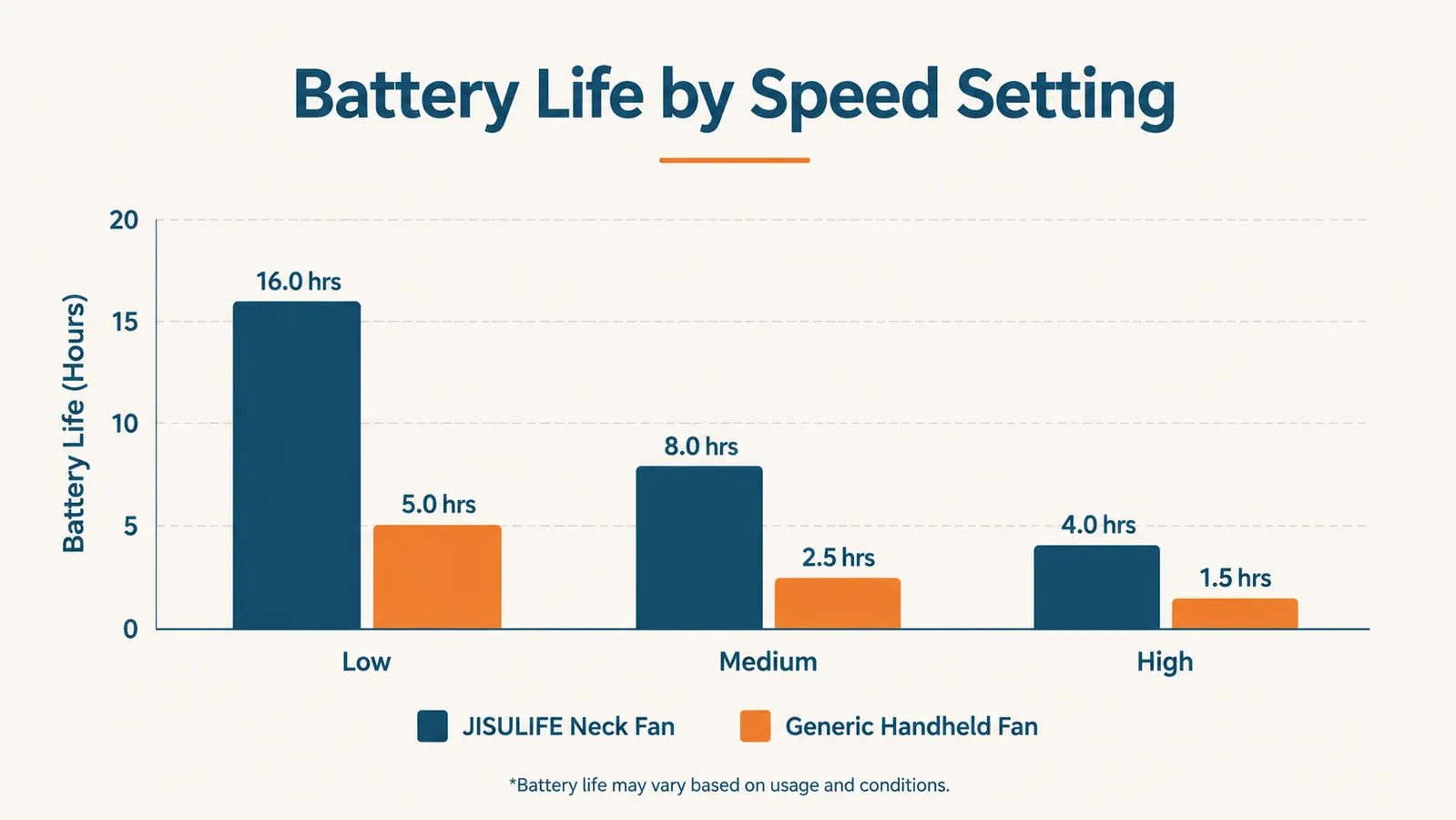
| Battery Life | 4,000 mAh, roughly 16 hours on the lowest of 5 speeds | Typically 1,500 to 2,000 mAh, closer to 3 to 5 hours on low |
| Weight in Use | About 7.8 oz, but it rests on your shoulders, so it feels weightless after a minute | About 4 to 5 oz, but every ounce is held in your palm the whole flight |
| Noise at Top Speed | A steady, noticeable hum, similar to a desk fan on low | Quieter on its lowest setting, but a sharper buzz once you crank it up |
| Speed Settings | 5 speeds with a single button cycle | Usually 2 to 3 speeds, often a twist dial |
| Charging | USB-C, full charge in about 2.5 hours | Micro-USB or USB-C depending on the model, generally 1 to 2 hours |
| Best Suited For | Walking terminals, rolling a bag, standing in line, holding a kid's hand | Sitting at a gate or in a seat with nothing else to hold |
Where the JISULIFE Wins
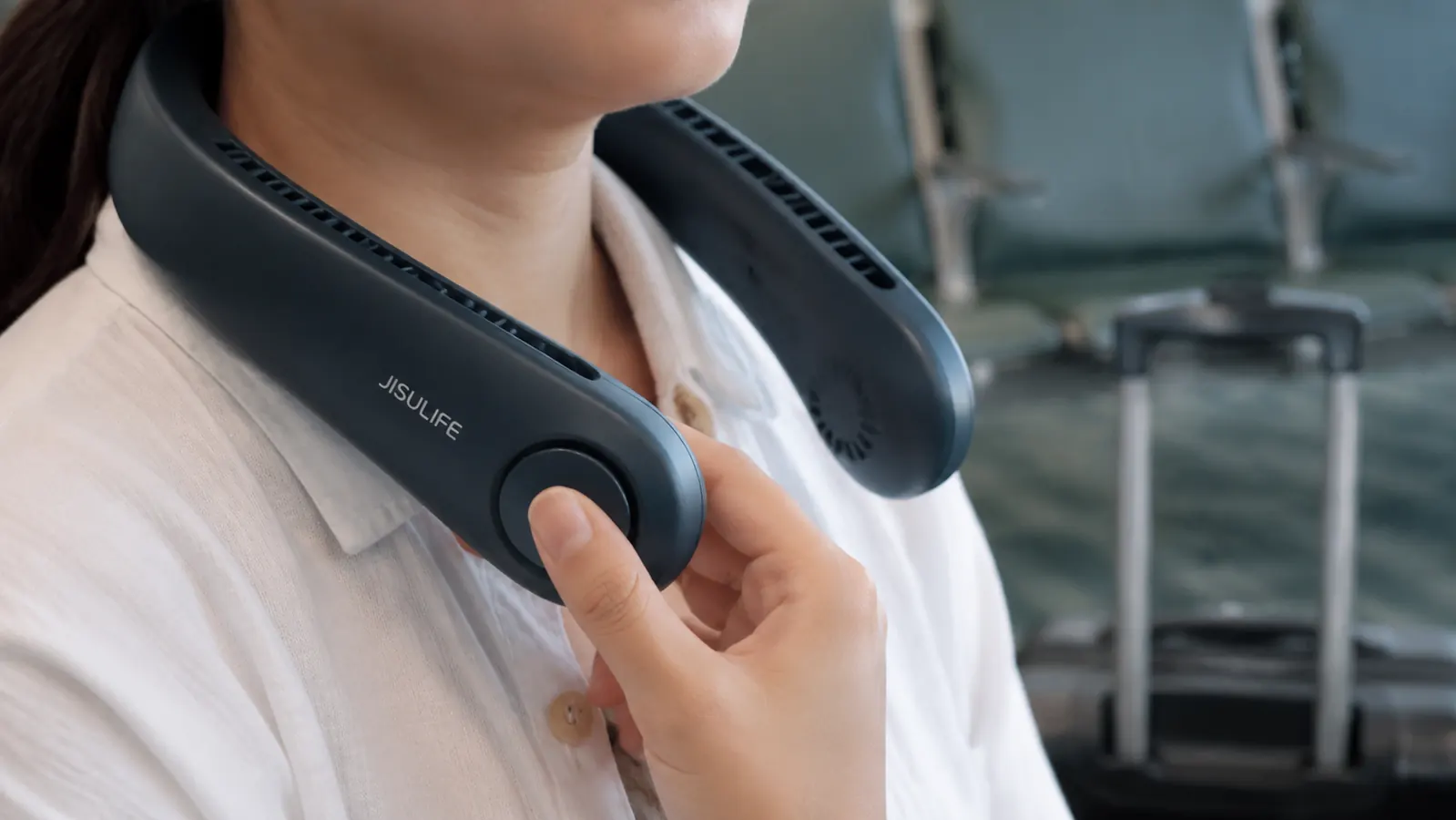
The entire advantage of the JISULIFE comes down to one design decision: it hangs around your neck instead of living in your hand. That sounds like a minor convenience until you're the person power-walking through Charlotte's C concourse with a rolling bag in one hand, a backpack strap in the other, and a boarding pass clenched between your teeth because your connection closes in eleven minutes. I've been that person, more than once. A handheld fan in that scenario isn't cooling you off, it's getting shoved into a jacket pocket where it does absolutely nothing for the rest of the sprint to the gate.
With the neck fan, I had airflow the entire walk, no juggling required, no decision about which hand gets sacrificed. The dual vents blow up along your jawline and neck from both sides, which covers more surface area than a single handheld blade ever will, and the 5 speed settings mean you can dial it down to a quiet breeze for a quiet gate or crank it to setting 5 the moment you step off a jet bridge into 96 degree tarmac heat. That range matters more than a spec sheet makes it sound, because a fan that only does one intensity well is a fan you stop reaching for half the time.
Battery life is the other real gap, and it's not a small one. On the Denver trip I ran the JISULIFE on speed 2 for almost the entire travel day, roughly 9 hours door to door, curb to rental counter, and it still had charge left when I checked into the hotel that night. A handheld fan that size simply doesn't carry a battery that large, because it isn't designed to sit against your body all day, it's designed to be light in your palm for short bursts. Different engineering goal, different result once the day runs long and the gate changes twice.
There's also a practical safety angle I didn't expect to care about until I was traveling with my nephew last spring. A neck fan stays put around your own shoulders, out of a toddler's reach, while a handheld fan in a busy terminal is one bump away from getting dropped, stepped on, or handed off mid-tantrum. It's a small thing until it's the thing that saves your fan from a cracked housing on the jet bridge.
Build quality holds up better than I expected over repeated trips too. Mine has gone through TSA bins, gotten stuffed into a backpack side pocket next to keys, and been rained on waiting for a rideshare, and the housing hasn't cracked or loosened. The rubberized band around the neck flexes without feeling flimsy, and the vents haven't rattled loose the way a cheap handheld's blade guard eventually does after a few trips in a suitcase.
The moments I actually need cooling are the moments my hands are already busy with something else. A handheld fan can't cover that. A neck fan doesn't have to try.
Where the Handheld Fan Wins
I'm not going to pretend the handheld fan is useless, because it isn't, and an honest comparison has to give it its due even when I know which one I'm packing next time. If you're the kind of traveler who books a window seat, puts your headphones on, and doesn't move from boarding to landing, a handheld fan is lighter to pack, cheaper to buy, and gives you direct, aimable airflow right at your face in a way a neck fan can't quite match. When I sat still at my Tampa gate for 40 minutes before boarding, I actually preferred pointing the handheld fan straight at my forehead over the more ambient, jaw-level airflow of the neck fan.
The handheld also wins on pure packing size and downside risk. It folds flatter, weighs less, and if it gets lost in a seat pocket or snaps in a suitcase, you've lost far less than you would with the neck fan. For a once-a-year vacation flier who wants a cheap backup fan tucked in a carry-on side pocket and doesn't move much between security and the gate, that's a legitimate, honest case to make. It's just a narrower slice of what a real travel day actually looks like for most people I know.
There's also a social factor worth naming honestly. A handheld fan pointed at your own face reads as personal and unobtrusive in a tight waiting area. Some travelers feel a little self-conscious wearing a device around their neck in public, even a genuinely useful one, and that discomfort is real even if it has nothing to do with performance. If that's you, the handheld fan may simply feel like the more comfortable choice regardless of what the spec sheet says.
It's also worth mentioning quiet-room settings, a library, a shared office, a hushed hotel lobby, where the neck fan's steady hum is more noticeable than a handheld fan turned to its lowest setting and aimed briefly at your face. If most of your fan use happens in places like that rather than open concourses, the handheld's lower baseline noise on low is a genuine point in its favor, even though the neck fan still wins on raw airflow once you turn it up.
Your hands are already full. Your fan shouldn't need one too.
The JISULIFE neck fan is the one I actually reach for when I'm walking a terminal, not sitting in one. Check today's price on Amazon before your next trip.
Amazon Check Today's Price on Amazon →
Who Should Buy Which
If your travel day involves connections, rolling luggage, kids, strollers, or any real amount of walking through a hot terminal, the JISULIFE is the clear pick. It's the one piece of gear that keeps working while your hands are doing everything else, which is exactly when overheating actually happens, not while you're comfortably seated with a drink cart nearby. If you're a window-seat, headphones-on, minimal-movement flier who rarely deals with tight connections and just wants a cheap breeze while seated, the handheld fan will do the job for less money and less bulk in your bag.
I still keep a cheap handheld fan in my desk drawer at home for exactly that kind of stationary use, reading on the porch or sitting at my kid's outdoor soccer game. It just doesn't come to the airport with me anymore. The JISULIFE does, every single trip, because the moments I actually need cooling are the moments my hands are busy with something else, a bag handle, a passport, a coffee, a kid's sleeve, and that's precisely the situation a handheld fan can't cover no matter how good its little motor is.
This also comes up a lot when people ask me for gift ideas for a frequent flyer in their life. The handheld fan feels like a stocking stuffer, small and forgettable. The JISULIFE feels like something a road warrior actually reaches for on every single trip, which is the difference between a gift that gets used once and one that earns a permanent spot in the carry-on.
If you travel maybe twice a year and mostly sit, save your money and grab the handheld. If you're in and out of airports regularly, dealing with connections, or traveling with anyone who needs a free hand from you, spend the extra few dollars once and stop thinking about it. That's the whole decision, and it's the one I made after enough hot, hands-full terminal walks to trust it.
Hands-free beats hand-held on a real travel day.
See current pricing and availability for the JISULIFE Portable Neck Fan on Amazon.
Amazon Check Today's Price on Amazon →