

I bought my JISULIFE Portable Neck Fan in late May 2025, three days before a connection through Phoenix that I already knew was going to be miserable, because the gate agent at my previous stop had warned me the AC in Terminal 4 had been running warm for a week. I fly carry-on only, and I'm not usually someone who buys gadgets on impulse, but I'd watched three different people on a delayed flight the month before fan themselves with a boarding pass for forty minutes straight and I decided I wasn't doing that again. Nine trips and one full summer later, spanning Phoenix, Newark, Charlotte, and a genuinely brutal layover in Dallas in July, the JISULIFE is still clipped to the outside pocket of my backpack. This isn't a review written after one hot afternoon. It's what I actually think after using it on real delayed flights, real crowded gates, and one memorable ninety-minute tarmac hold outside Atlanta where the plane's AC gave out.
My old approach to airport heat was a mix of standing near whatever vent I could find and buying an overpriced bottled water to hold against my neck, which is a generous way of saying I had no plan at all. The JISULIFE promised something different: a bladeless, hands-free fan you wear around your neck, with 5 speed settings and a 4000mAh battery, so you're not standing there holding a handheld fan for two hours until your arm gets tired. At 36.99 dollars and just over 4.3 stars from more than 62,000 reviewers when I bought mine, it looked like the kind of gadget that either becomes essential or ends up in a junk drawer within a month. I wanted to find out which one it would be for me.
The Quick Verdict
After a full summer of layovers, the JISULIFE earns its spot in my carry-on for genuine hands-free relief and real battery life on the lower speeds, but the top speed is loud enough to draw looks and the airflow drops off fast past a foot from your face.
Amazon Check Today's Price →Tired of Fanning Yourself with a Boarding Pass?
I used to stand near vents and hope. A hands-free fan that clips around your neck and runs for hours on the lower settings has replaced that entirely, and it's still going strong nine trips in.
Amazon Check Today's Price on Amazon →How I've Used It
My test conditions were not gentle. I keep the JISULIFE clipped to the outer mesh pocket of my backpack, not padded or protected in any way, so it's been bumped against gate seating, dropped once on the jet bridge in Charlotte, and generally treated the way most of my gear gets treated on a rushed travel day. It's been used in a range of real conditions, from a genuinely sweltering gate in Phoenix where the display board showed a 40 minute delay that turned into 90, to a merely stuffy connection in Newark where I mostly ran it on the lowest setting just as background comfort. That range matters, because a device that only performs during a controlled test isn't actually useful, it's a gadget that looks good in a product photo.
The part I use it for most isn't actually the worst-case scenarios, it's the boring middle of a travel day. Standing in a security line, waiting at baggage claim, sitting at a gate with no outlet nearby and nothing to do but wait. Being hands-free is the whole point for me. I can drag my roller bag, hold my phone, and dig through my personal item for my ID all while the fan keeps running, which is something a handheld fan simply can't do unless you have a free hand to spare, and on a travel day I never do.
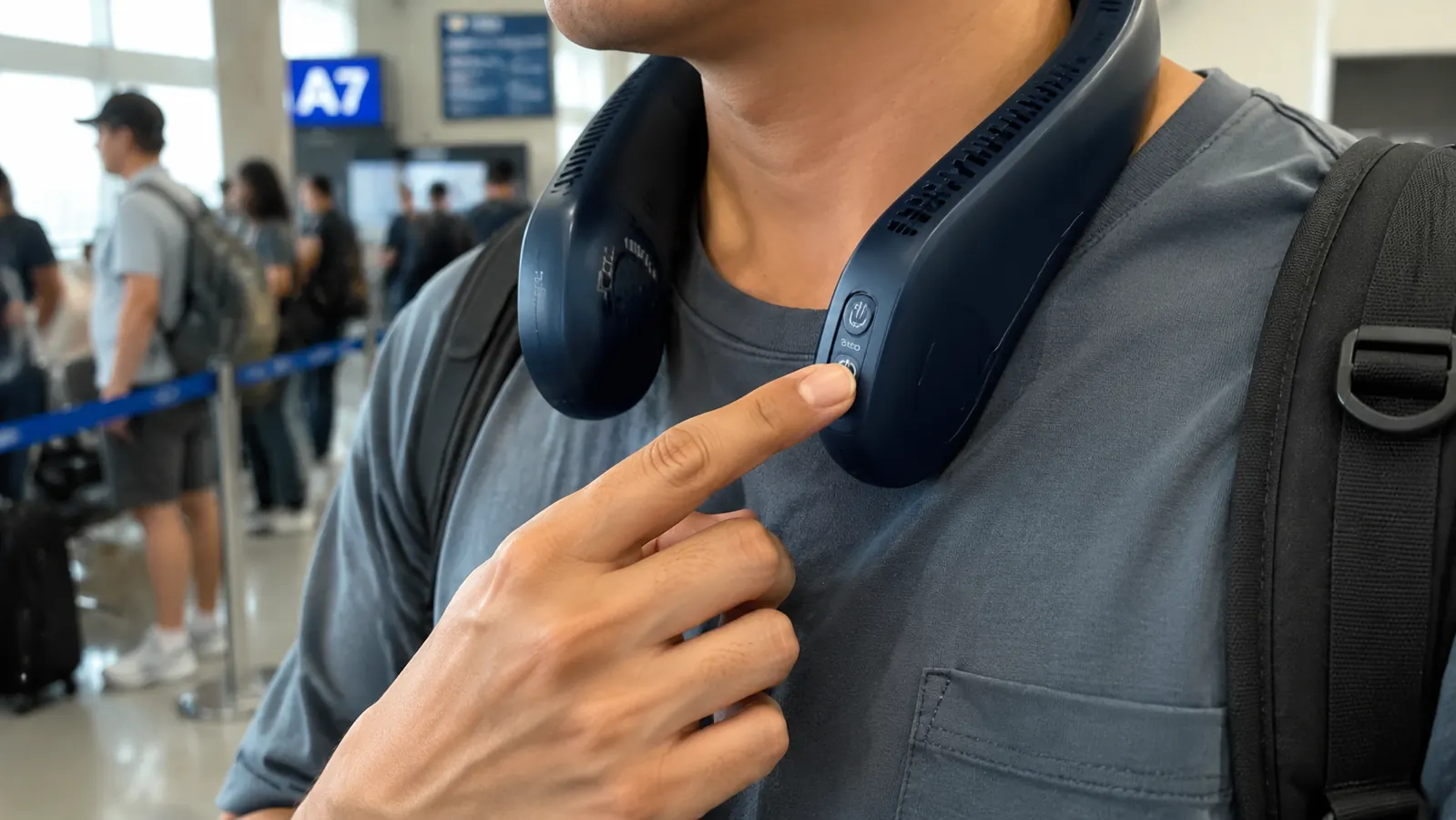
The bladeless design took some getting used to. There's no spinning blade you can see or touch, just two vents that push air out from the sides, so my first instinct was to assume it wouldn't move much air compared to the small handheld fans with visible blades that I'd used before. On the lowest two speeds, that instinct was mostly right, the airflow is gentle. On speeds 3 through 5, it's a genuinely strong stream of air directed up toward your jaw and cheeks, enough that in the Dallas layover I actually felt my hair moving.
The Bladeless Design and Why It Actually Matters
The bladeless design isn't just a safety gimmick for parents worried about small kids grabbing at it, though that's a real benefit if you travel with a toddler like my sister does. It also means the fan sits flush against your neck without catching on a scarf, a lanyard, or loose hair the way an exposed-blade fan can. I have long hair, and with two previous small clip-on fans I owned before this one, I'd occasionally get a strand pulled into the blade guard. That hasn't happened once with the JISULIFE in nine trips, and it's a small thing that matters more than I expected once I stopped having to think about it.
The tradeoff is that bladeless fans generally move less total air than a comparable blade fan of the same size, and I noticed that most clearly when I tried using it away from my neck. Held out at arm's length toward a laptop screen to cool it down during a delay, it did almost nothing. This is a fan designed to work at neck distance, blowing air up past your jaw toward your face, not a general-purpose desk fan you can point anywhere and expect results. Once I stopped expecting it to behave like a desk fan, my opinion of it improved considerably.
The neck band itself is a semi-rigid plastic, flexible enough to bend open and closed around your neck without feeling like it's going to snap, and it hasn't lost its shape after nine trips of being clipped, unclipped, and shoved into a backpack pocket. It weighs close to nothing, light enough that I genuinely forget I'm wearing it sometimes, which was a pleasant surprise given how bulky some of the reviews photos made it look before I bought mine.
Battery Life Across a Full Summer of Layovers
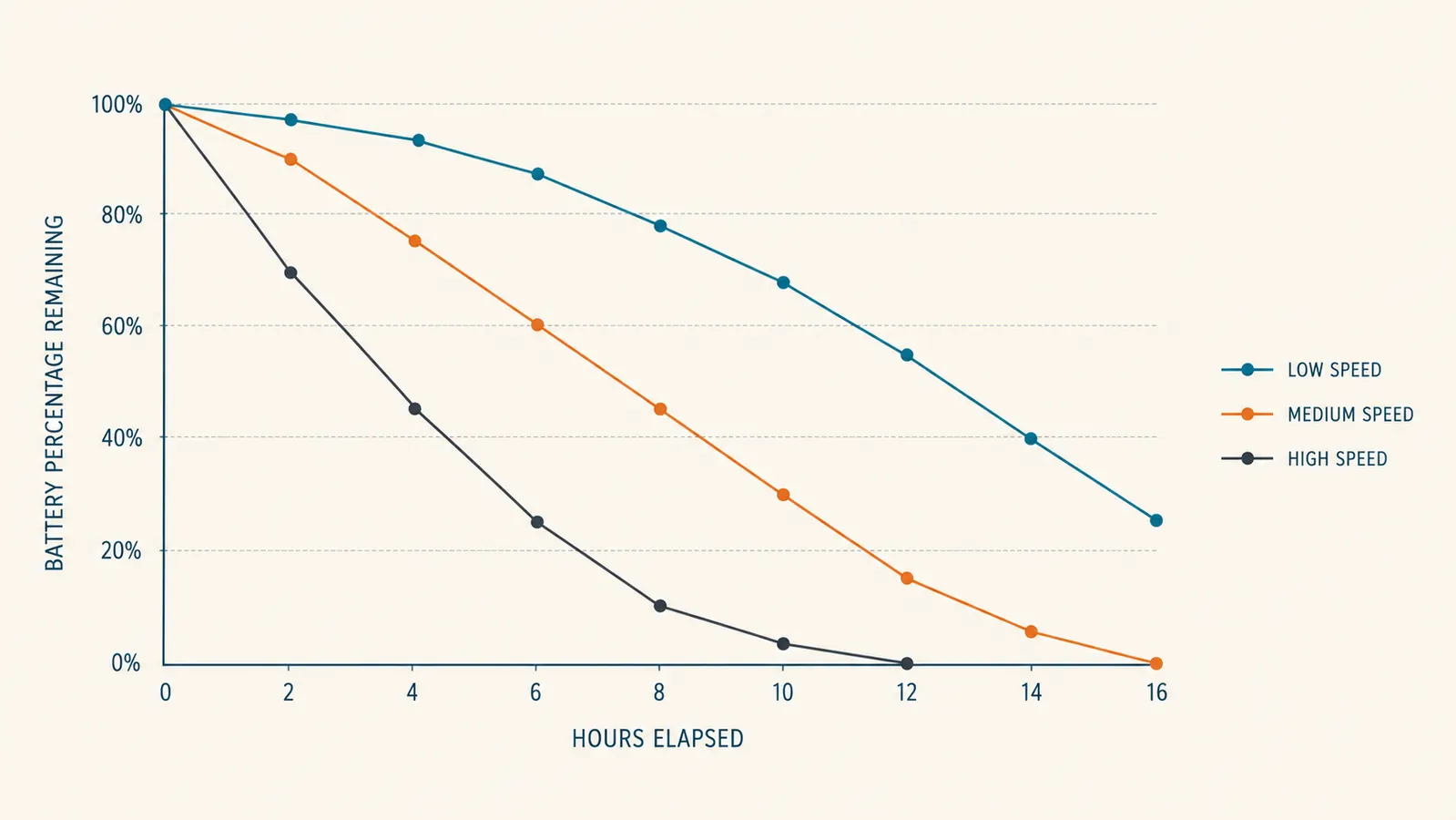
This is where the JISULIFE either earns its keep or doesn't, because a fan that dies halfway through a delay is worse than no fan at all, it's just dead weight in your bag. On the lowest setting, I've gotten close to the claimed 16 hours on a single charge, which I verified during a long day that included a 3 hour layover in Charlotte and a delayed evening flight where I ran it on and off for most of the day. On speed 3, the middle setting I use most often, I'm consistently getting somewhere around 6 to 7 hours of continuous use before it needs a charge. On the top two speeds, which I only use during genuinely hot moments like the Dallas layover, battery life drops fast, closer to 2 to 3 hours of continuous top-speed use.
Charging is USB-C, which matters more than it sounds like it should, because it means I can charge the fan off the same brick and cable I already carry for my phone and laptop, no separate adapter cluttering up my bag. A full charge from dead takes roughly 2 hours in my experience, plugged into a wall outlet at a gate rather than a laptop USB port, which charges noticeably slower. I've started plugging it in overnight at hotels out of habit now, the same way I do my phone, so it's rarely below 70 percent when I actually need it.
The one battery-related annoyance is that there's no percentage readout, just a small LED that changes color as it gets low, so I've been caught off guard twice by it dying faster than expected when I'd been running it on a higher speed longer than I realized. I've gotten better at just checking the LED color before I board a flight rather than assuming it's fine, but a numeric readout would have saved me the guesswork.
Noise, Airflow Strength, and the Tradeoffs Nobody Mentions
On speeds 1 and 2, the JISULIFE is quiet enough that I've worn it during a phone call without the person on the other end noticing. Speed 3 introduces a noticeable hum, not loud exactly, but present enough that I've had a seatmate glance over on a quiet flight before I realized I still had it running. Speeds 4 and 5 are genuinely loud, a whirring buzz that carries further than I expected, and I mostly reserve those for moments when I don't care about drawing attention, like standing alone at an empty gate during a delay rather than sitting shoulder to shoulder with strangers.
The airflow strength drops off faster with distance than the marketing photos suggest. Directly against your neck and jaw, even speed 2 feels meaningfully cooling. Move your head six inches away, adjusting the band or leaning forward to dig through a bag, and the effect drops noticeably. This isn't a flaw exactly, it's just a fan designed for close-range use, but it means the fan only really works when it's actually positioned correctly around your neck, not draped loosely or hanging off to one side, which happens more than I'd like when I'm also wearing a backpack strap that competes for the same real estate.
How It Compares to the Handheld Fan I Used to Carry
Before the JISULIFE, I carried a small folding handheld fan that cost about half as much. It was fine for standing still, but the second I needed a free hand, which on a travel day is constantly, it either got tucked away or I awkwardly held it between my shoulder and ear. The handheld fan also had a wider, more direct airflow when pointed straight at my face, which the neck fan genuinely can't match at close range if I'm being honest. There were a few moments in the Dallas heat where I actually missed being able to point a strong, direct blast of air right at my forehead.
What the handheld fan couldn't do was run continuously while I dealt with the actual logistics of traveling, and that's the tradeoff that ultimately matters more to me. A handheld fan is more powerful in short, direct bursts. A hands-free neck fan is less powerful per second but useful for a much larger percentage of an actual travel day, because it's running the whole time instead of only when I remember to pull it out and hold it up. For someone who flies as often as I do, coverage across the whole day has turned out to matter more than peak power in any single moment.
What I Liked
- Genuinely hands-free, works while pulling luggage or digging through a bag
- Bladeless design hasn't caught my hair once in nine trips, unlike my old clip-on fan
- Real battery life, close to 16 hours on the lowest speed
- USB-C charging means one less cable and adapter in my bag
- Light enough that I forget I'm wearing it on longer walks through terminals
Where It Falls Short
- Top speeds are loud enough to draw glances in a quiet gate area
- Airflow drops off fast more than six inches from your face
- No battery percentage readout, just a color-changing LED
- Weaker direct airflow than a handheld fan pointed straight at your forehead
The best compliment I can give it is that I stopped thinking about it. It's just around my neck, running quietly on speed 2, the same way my sunglasses are just on my face, and after a full summer of delays that's not nothing.
Who This Is For
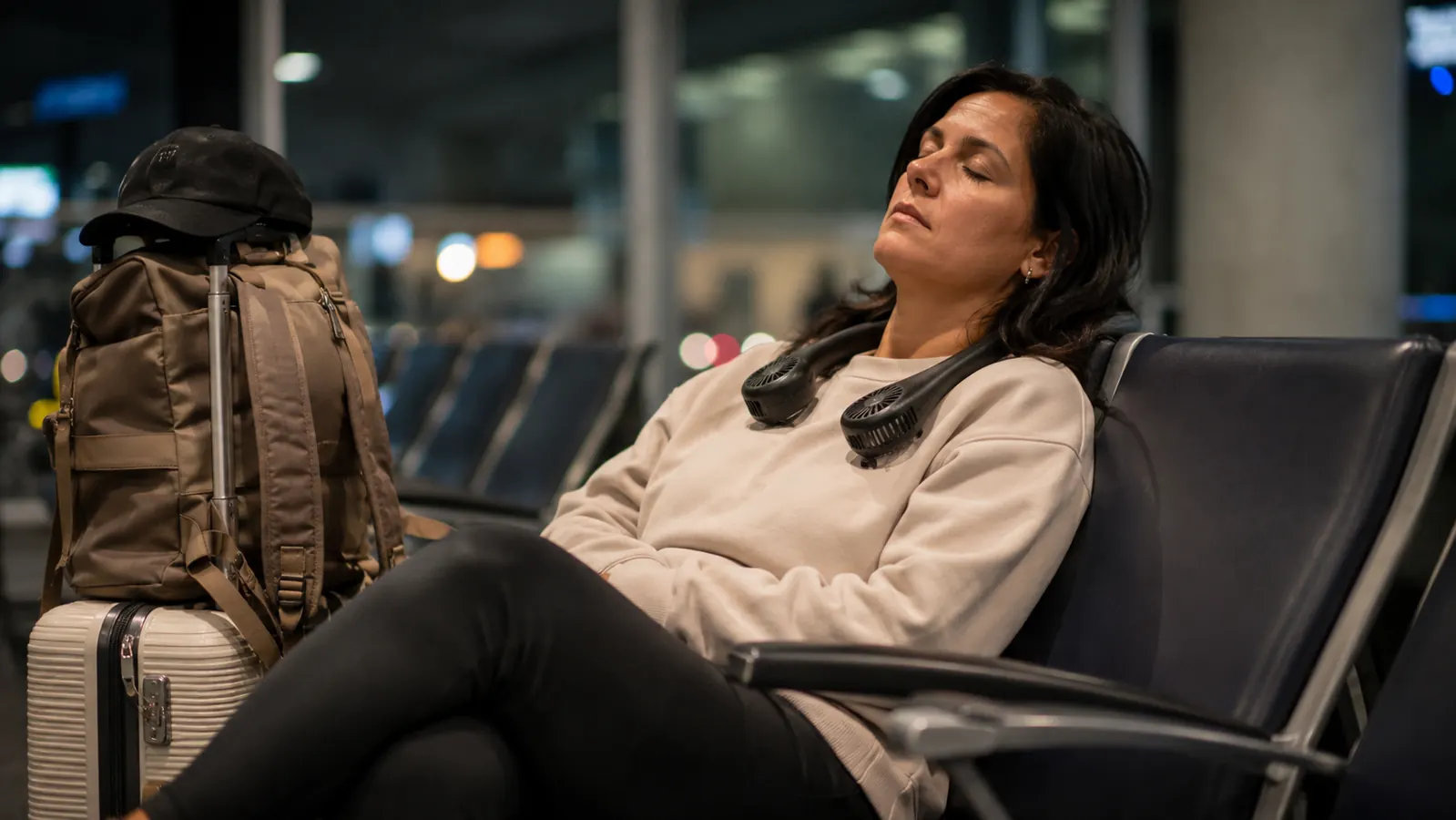
If you fly through hot connecting airports regularly, or you're prone to overheating during long security lines and delays, this is a legitimately useful piece of gear, especially if you already know you'll have your hands full with luggage. It's also a good pick for anyone who wants background cooling for hours at a time rather than a short powerful blast, since the lower speeds are where the battery life really shines.
Who Should Skip It
If you mostly want maximum direct airflow pointed right at your face in short bursts, a simple handheld fan will outperform this at close range, and it's cheaper too. It's also not the right pick if you're sensitive to noise around others, since the top two speeds are loud enough that I wouldn't run them on a quiet flight or in a library-quiet lounge. For everything in between, the tradeoff has worked in the JISULIFE's favor for me.
A Full Summer of Layovers Later, It's Still Clipped to My Bag
Hands-free cooling that actually lasts through a real delay, not just a demo video. If your next connection is somewhere you already know will be hot, this is the swap I'd make first.
Amazon Check Today's Price on Amazon →